
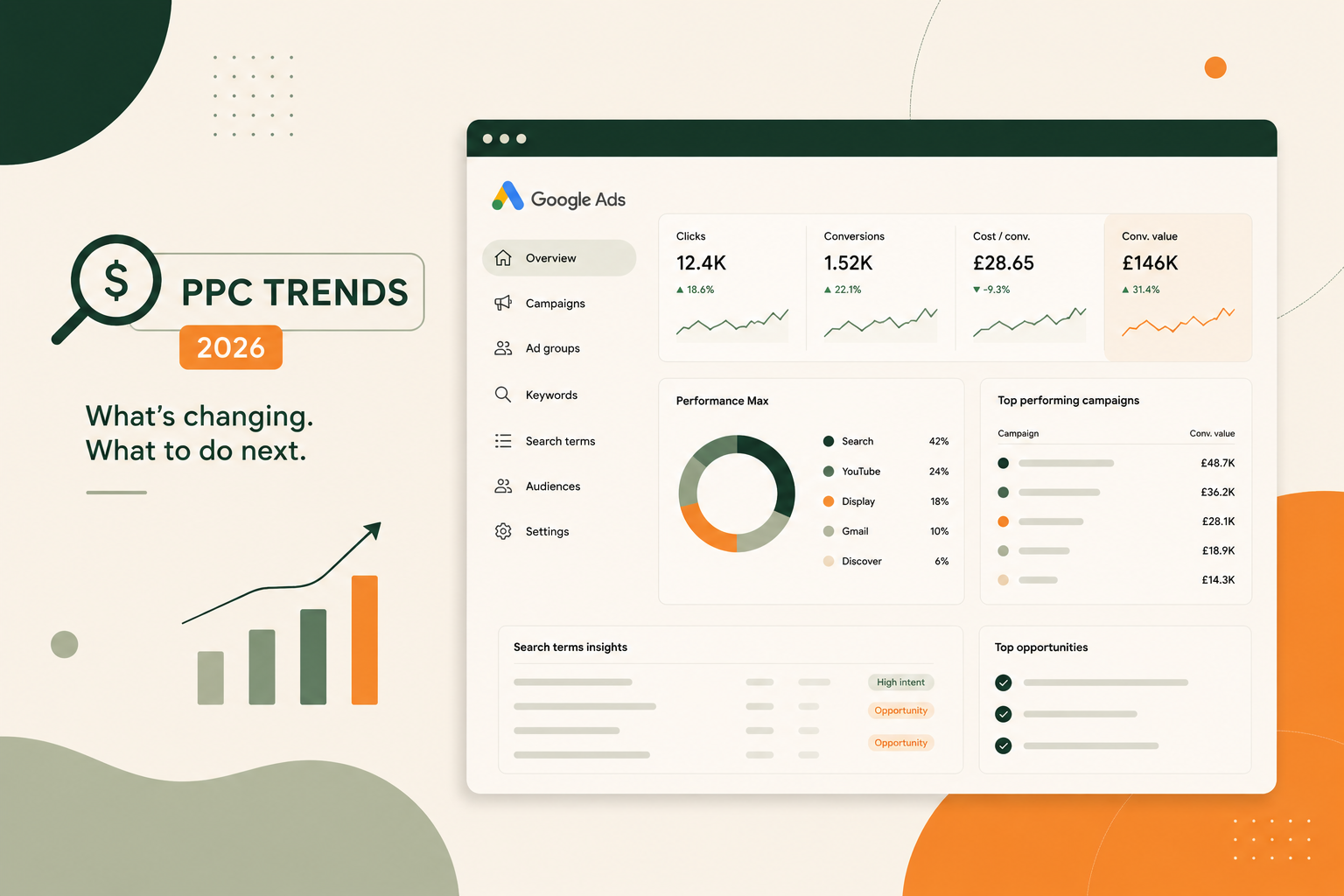
You glance at your Google Ads dashboard and the numbers look reasonable. The cost per click is a bit higher than last year, but your agency says that is normal. What they may not have told you is how much the platform has changed and what that means for how your campaigns should be structured in 2026.
This piece is written for business owners and marketing managers who use Google Ads, whether they manage accounts themselves or work with an agency. It covers the five changes that are affecting campaigns right now, what to check if you are running your own account, and the questions worth putting to your agency if you are not.
Google Ads in 2026 Is Not the Same Platform It Was Two Years Ago
Google Ads has moved from a tool you configure to a system that makes decisions on your behalf. The traditional model, where you picked keywords, wrote ads, and set bids manually, was transparent. You knew what you were targeting and why. The 2026 model is built around AI-powered campaign types (Performance Max, AI Max), broad match keywords, and automated bidding strategies that optimise toward goals you define rather than the specific searches you choose.
The platform now uses layers of signals including demographics, browsing behaviour, and historical performance data to decide when and where your ads appear. This means the same broad keyword can trigger very different searches across different users. The advertiser decides less. The platform decides more.
For a UK business owner, this has two clear implications. First, you need an agency or manager who understands how to set guardrails within these automated systems. Knowing how to bid on a keyword list is no longer sufficient. Second, you need to understand enough about how the system works to ask the right questions. Our Google Ads management service is built around exactly this balance: structured automation with clear strategic input at every stage.
Five Changes in PPC That Affect Your Budget Right Now
1. AI is managing more of your campaign, but it needs better input. Google has embedded automation into the default setup of most campaign types. AI Max and Performance Max campaigns use machine learning to choose where your ads appear, who sees them, and what your ads say through responsive search ads that mix and match headlines and descriptions. The quality of what you put in directly determines what the system produces. If your account has weak ad copy, limited conversion data, or vague location targeting, the AI has less to work with. The results reflect that directly.
2. First-party data is now essential, not optional. Third-party cookies are being phased out across browsers. The interest-based targeting that made display and remarketing campaigns effective in earlier years is weakening as a result. First-party data, meaning information your business collects directly from its customers through its own website, CRM, or email list, has become the primary source for building accurate targeting audiences. A Google Ads account without a customer list upload, a properly configured GA4 property, or a working remarketing tag is operating without the signals that now matter most. If your analytics setup needs attention, a website audit is the right starting point.
3. Keywords matter less, but search terms still do. Most campaigns now run on broad match, which allows Google to serve ads on searches far removed from the exact keywords you have chosen. This can unlock genuinely useful traffic you would never have bid on manually. It can also burn budget on irrelevant searches. The difference between those two outcomes is the quality of your negative keyword list and how regularly your search terms report is reviewed. An account that has not had a negative keyword review in the past 90 days is almost certainly wasting a portion of its budget.
4. Creative quality is a new performance lever. As targeting becomes more automated, ad creative has become one of the few remaining areas where a business can differentiate. Google’s responsive ad formats let the platform generate variations of your ads, but the quality of those variations depends entirely on the assets you provide. Generic headlines and stock images produce generic results. Businesses investing in authentic photography, specific messaging, and visually distinctive creative are seeing material improvements in click-through rates across display and Performance Max campaigns. Strong content marketing supports PPC directly because it gives the platform better signals to work with.
5. Reporting has become harder to interpret, not easier. A growing proportion of search terms are now aggregated or hidden in Google Ads reporting, particularly in AI Max campaigns. You may not be able to see exactly what searches triggered your ads or precisely where your budget went. This is an intentional platform decision, not a bug. The implication is that good PPC management now requires more sophisticated measurement, including Google Analytics 4 integration, conversion value tracking, and regular experiments, rather than simply reading campaign-level numbers at face value.
What This Means If You Are Running Google Ads Without an Agency
If you manage your own Google Ads account, the platform has become more powerful but also more opaque. Three things are worth checking now.
Switch on enhanced conversions if you have not already. This setting allows Google to use hashed customer data to fill in attribution gaps left by cookie limitations. It is found in your Google Ads account settings under Conversions. Setup takes around 30 minutes, costs nothing, and improves the data the platform uses to optimise your campaigns.
Audit your search terms report every month. Filter by cost and sort by clicks. Identify any searches that triggered your ads but do not match what you sell, then add them as negative keywords. In a well-managed account, this review should take no more than 20 minutes and can recover a meaningful proportion of wasted spend. If you have not done this review in the past 90 days, it is likely that some of your budget has been directed at irrelevant searches.
Review your campaign type. If you are running standard search campaigns only, you may be missing coverage available through Performance Max. But if you have already switched to Performance Max without setting asset group targets, location exclusions, and brand safety filters, the campaign may be less targeted than it appears. The switch to automated campaign types is not automatic improvement. It requires setup and ongoing management to deliver the right results.
Questions to Ask Your PPC Agency
These five questions are designed to give you a clear view of whether your agency is managing your Google Ads to the standards the platform now requires. A well-run agency will welcome the conversation. One that cannot answer these questions specifically is a useful signal in itself. They sit alongside the broader question of whether your digital marketing services are delivering the return they should.
1. Which campaign types are currently active in our account, and why were they chosen over alternatives such as Performance Max or AI Max? The answer should explain the strategic rationale, not just name the campaign types.
2. How often are you reviewing our search terms report, and can you show me the negative keywords you have added in the past 30 days? This should produce a specific list, not a general assurance.
3. Are we using any first-party data audiences, such as customer lists or GA4 audiences, to inform how Google targets our ads? If the answer is no, that is worth exploring. If the answer is yes, ask how those audiences are being maintained.
4. How is conversion tracking set up, and are we measuring the actions that lead to actual sales rather than just website visits? Tracking clicks and sessions is not the same as tracking enquiries, calls, or purchases.
5. What does success look like in our account right now, and how does that definition account for the fact that click-through rates and impression share do not always reflect business results? An agency thinking carefully about this will have a clear answer. One focused primarily on activity metrics is worth questioning.
FAQ: PPC in 2026
Is PPC still worth the money for small businesses in 2026?
Yes, for most businesses with a clear product or service and a defined target area. Google Ads remains one of the most direct ways to put your business in front of people who are actively searching for what you offer. The platform has changed significantly, but the underlying intent-based targeting that makes it effective for small businesses has not. The key difference in 2026 is that effective management requires more strategic input than it did two years ago. If you are questioning whether your campaigns are delivering, get in touch and we can review what you are currently running.
What is Performance Max and should my business be using it?
Performance Max is a Google Ads campaign type that uses machine learning to serve ads across all Google channels, including Search, Display, YouTube, Gmail, and Maps, from a single campaign. It is powerful when set up correctly with good asset quality, clear conversion tracking, and appropriate audience signals. It can waste significant budget when it is not. Whether your business should be using it depends on your account history, conversion data quality, and how well your current setup is configured. It is not a universal improvement.
What is first-party data and do I need it for Google Ads?
First-party data is information your business collects directly from its own customers: email lists, purchase histories, website visitor data captured through your own tools. In the context of Google Ads, it allows you to build targeting audiences based on people who have already interacted with your business, which typically converts far better than cold audiences. As third-party cookie tracking weakens, first-party data has become increasingly important for maintaining campaign performance. If your account is not using any first-party data, you are missing a significant targeting advantage.
How do I know if my Google Ads agency is doing a good job?
Look beyond the metrics they report and focus on what those metrics connect to. Impression share, click-through rate, and average CPC are useful data points, but they do not tell you whether your Google Ads investment is generating enquiries, calls, or sales. A well-run agency will report on conversion volume and cost per conversion, will be able to show you recent search term audits and negative keyword additions, and will be clear about what campaign types are running and why. If your monthly report consists primarily of traffic data without business outcome metrics, that is worth raising directly.
Has Google Ads become too automated for small business budgets?
Not if it is managed correctly. Automation in Google Ads reduces the time required for routine optimisations like bid adjustments, but it increases the importance of strategic decisions about campaign structure, conversion tracking setup, and asset quality. These are areas where human judgement still matters significantly. A small business with a monthly budget of £1,000 to £3,000 can still run effective Google Ads campaigns in 2026, but the management approach needs to be appropriate to how the platform now works.
Ready to check whether your Google Ads campaigns are set up for how the platform works in 2026? Find out more about our Google Ads management service or get in touch to talk through what effective PPC management looks like for your business.
Keep reading.

SEO Trends 2026: What UK Businesses Actually Need to Know
The search trends UK businesses need to understand in 2026, from AI Overviews and E-E-A-T to intent, zero-click searches and technical SEO.
Read article →
Email Marketing for Small Business: A Practical UK Guide
A plain-English guide to email marketing for UK small businesses. From building your list to writing campaigns that get results, here's how to start and what to do.
Read article →